
Soviet forces were overwhelmingly better-armed
and -equipped than Finnish troops. A Soviet infantry division was slightly
larger than it's Finnish counterpart and had more machine guns. It
also had more motorized vehicles and had a tank company of 40 tanks.
Artillery
had more and heavier guns than Finnish forces. Also there was unlimited
ammo available. The motorization of Soviet forces was not an asset
in the Finnish terrain. It tied troops to the roads and they were easily
encircled. Soviet close combat weapons were inadequate
since they had no submachine guns available. Training was inadequate:
for instance the Soviets had't taken the grease out of their
automatic rifles, so they froze and jammed.
In the late part of the war Soviets began to use
some ski troops but these were inferior compared to Finns. Soviets made poor
use of tanks, usually having them follow infantry. Tanks
were taken out of action by few Finnish AT-guns or they drove independently
to the rear and were taken out with Molotov Cocktails or AT-Grenades,
since they had no protecting infantry. Later Soviets tried keep infantry
with the tanks by using armored sleighs.
Soviet tanks of this time were of poor quality,
mostly T-26, BT-7 or T-28. The Red Army lost about 3500 tanks
in the Winter War. Nearly half of them were breakdowns, and some could be
repaired later.
The Soviet Airforce had the I-16, I-15 and I-153 fighters,
SB-2 and the DB-3 bombers. Their pilots were inferior in quality
compared to Finnish ones. The Soviet Airforce lost about 700 planes, most of them
were shot down by AA-fire.
Strategy
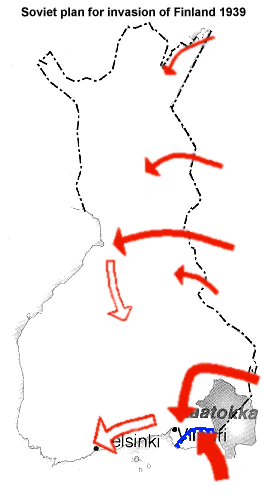
The Soviet plan for invasion in the Winter War is illustrated below. In the first phase the 7th Army was to attack the Mannerheim Line (the blue line in the Isthmus), as the 8th Army fights its way around Lake Ladoga and strikes to the rear of the defenders of the Mannerheim Line. The 9th Army cuts the Finland in two halves, and advances to the Swedish border. The main limitation of strenght in the operational areas of 8th, 9th and 14th Armies was defined by the poor transport facilities in the Soviet Karelia. Finns were however surprised by the number of forces deployed. The most recent Russian research points out that the Murmansk railroad and the poor roads were stressed to their maximum capacibility. The 14th Army secures the coast of the Arctic Sea against Allied invasion and advances to the south.
In the second phase the forces in south advance to Helsinki, as the northern 9th Army sweeps to south. It was believed that by the time Helsinki has been taken, the Finnish resistance will collapse and the war will end.
The honour of taking Helsinki was reserved to the 1st Finnish Corps of the so-called "Democratic Government of Finland", which was a puppet government set up by Stalin after the first Finnish town was taken on 1st December. Only very few Finnish soldiers joined the "people's army", it never made even one division, though Finnish-speaking citizens of Soviet Union were drafted to fill up ranks. But so many people of Finnish origin were sent to the labor camps during the Great Terror that there simply were not enough recruits.
The Baltic Fleet
was also supporting
land forces with the battleships Marat and Oktyabrskaya
Revolutsiya, the cruiser Kirov, two squadron leader vessels,
15 destroyers, 52 submarines and 650 planes.
The Northern Fleet
was in the Arctic Sea
with 6 destroyers, 17 submarines and 150
planes.
The Soviet Airforce deployed some 800-1000 planes against Finland in the beginning.
 Germans in Finland during
the Continuation War
In the end of June 1941 Soviet Union had about 16
divisions under the command of the Northern Front against Finland.
The 23rd Army was in Carelian Isthmus with
the 21st (Mech.), 43rd, 115th (Mot.), 123rd, 142nd Divisions and the
35th Tank Brigade.
The 7th Army was in the area north of
Lake Ladoga with the 71st, 168th and 237th Divisions.
This army also had the 54th Division
in the Northern Carelia.
The 14th Army was in the Arctic with the 52nd,
122nd and 1st Tank Divisions in Salla. In Murmansk this Army had
the 14th and 104th Divisions. The 88th Division was in reserve.
The 8th Independent Brigade was in Hango.
The Baltic Fleet had 2 battleships, 2 cruisers, 28 destroyers, 48 motor torpedo boats and 65 submarines.
The Soviet Airforce had deployed 400-500 planes against Finland.
During
the trenches phase of the Continuation War Soviet forces were
deployed as follows:
The 23rd Army was in the Carelian Isthmus under
the command of the Leningrad Front with 3 divisions
The 7th Army was on River Svir under the command
of the STAVKA with
5 (1942)-3 (1944) divisions and some naval infantry
brigades.
The 32nd Army was in the Maaselkä Isthmus
under the command of the Carelian Front with 6 (1942)-4
(1944) divisions.
Armies in the German sector of the front:
The 26th Army was in Uhtua and Kestenga sectors
under the command of the Carelian Front with 5 divisions
and some naval infantry brigades.
The 19th Army was in the Vermajoki with
2 divisions.
The 14th Army was in the Murmansk sector
with 3 divisions and some naval infantry brigades.
For the attack of summer 1944, the Soviets had
deployed their forces in four armies under two fronts.
The 21st Army was in the Carelian Isthmus
under the command of the Leningrad Front with 15 divisions
(many of them Guards)
and lots of additional armor and
artillery units, which was to break through Finnish lines and
advance to Viborg.
The 23rd Army was in the Carelian Isthmus under
the command of the Leningrad Front with 6 divisions, which
had the secondary role in the attack on Carelian Isthmus.
Supporting these two armies were nearly 1000 planes, 628
tanks and assault guns.
The 7th Army was on the River Svir
under the command of the Carelian Front with 12 divisions.
Army's task was to take
Petrozavodsk and to liberate Soviet Carelia. It was supported by independent
armor brigades, assault gun regiments
and 350 planes.
The 32nd Army was in the Maaselkä Isthmus under
the command of the Carelian Front with 4 divisions.
This army's task was to liberate
the northern part of the Soviet Carelia.
Map of Carelia for finding the locations of the armies
Three armies were keeping an eye on Germans in the
Arctic and didn't take part in the attack:
The 26th Army was in the Rukajärvi and
Uhtua sectors.
The 19th Army was defending Kandalakhsha.
The 14th Army was defending Murmansk along
the River Litsa.